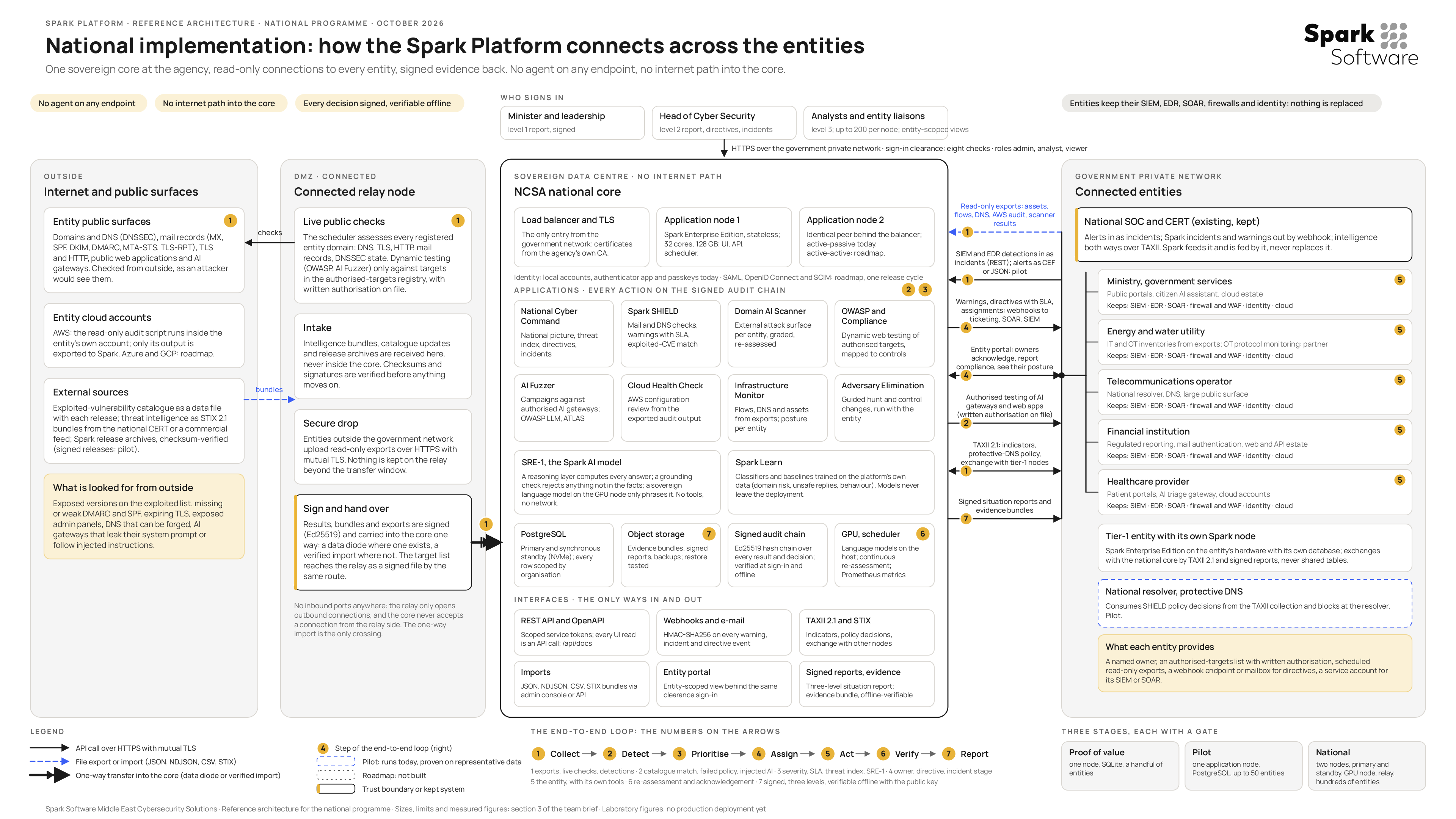
Spark does not replace the SIEM, EDR or SOAR your entities already run. It sits above them: it assesses every entity from the outside, tests the nation's AI before it goes live, fuses what the entities report into one national picture, directs the response and proves every decision with signed evidence.
One screen shows the national threat level, the entities behind it and whether the directive you issued was followed. Every number on it is signed and can be checked by anyone with the public key, without trusting Spark or the operator.
Every finding becomes a warning with an owner and an SLA; a directive is measured as compliance per entity; an incident moves through the national incident stages with a signed note at each step. The entities' SOC tools stay; Spark feeds them and is fed by them.
Inputs are public checks and read-only exports (assets, flows, DNS, the AWS audit output, scanner results) plus detections as incidents over REST. Outputs are HMAC-signed webhooks, TAXII 2.1, signed reports and an evidence bundle. PostgreSQL with a standby, an Ed25519 hash chain over every decision, an OpenAPI description at /api/docs.
Left to right: the internet and the entities' public surfaces, a connected relay in a DMZ, the national core in a sovereign data centre with no internet path, and the entities on the government private network. Pick a step of the loop to see which arrows carry it.
Generally available means running software in this platform, tested by its suites. Pilot means it runs today and is proven only on representative data. Roadmap means not built.
| Generally available | National Cyber Command · Spark SHIELD · Domain AI Scanner · OWASP and Compliance scanner (light depth) · AI Fuzzer (representative depth) · Cloud Health Check for AWS · Adversary Elimination as a guided workflow · SRE-1 and Spark Learn · sign-in clearance with authenticator and passkeys · user management · the signed audit chain · the Enterprise Edition (PostgreSQL, backups, TLS, Docker, systemd, OpenAPI, metrics) |
|---|---|
| Pilot | Infrastructure Monitor on real exports · entity posture from real telemetry · resolver enforcement of protective-DNS decisions · full-catalogue fuzzing with a detector per class and Arabic probe variants · alert-level ingestion from entity SIEMs (CEF or JSON) · signed release bundles and a software bill of materials |
| Roadmap | SAML 2.0, OpenID Connect and SCIM · SOAR actions and automated containment · web and API protection (partner) · OT protocol monitoring (partner) · Azure and GCP configuration review · live exploited-vulnerability feed synchronisation · active-active clustering |
| Not planned | Raw-log collection, search and retention · endpoint agents · running a 24/7 SOC for the entities. These stay with the entities' SIEM, EDR and SOAR by design. |
Measured on one laptop or one container: 520 requests per second with 32 clients, 10,000 signed audit entries written in 1.7 s and verified in 0.8 s. No production deployment yet; the pilot exists to measure the design targets on your hardware.
Against the cloud-native majors the differences are structural. Against self-hosted platforms they are not, and this table says so. "Not found" means not found in public documentation, not confirmed absent.
| Platform | Runs with no internet | Licence | Source open to the customer | AI red teaming | AI assistant without third-party AI |
|---|---|---|---|---|---|
| Spark Platform | YesNo internet path into the core by design | Perpetual for anything deployed; escrow on insolvency or change of control | YesSource open to the agency's reviewers | In the platform, offlineEvidence mapped to OWASP LLM Top 10 and MITRE ATLAS; a subset of the catalogue fires live today | YesSRE-1 on the host; a hosted open-weight language model only phrases the answer |
| Microsoft Sentinel and Defender | NoCloud services; not in Azure Local disconnected operations | Subscription | NoThe government source programme covers Windows and Office, not these products | Open-source tool and a cloud agent in previewPyRIT; Foundry red-teaming agent | NoSecurity Copilot runs on Azure OpenAI; prompts evaluated in ANZ, EU, UK and US |
| CrowdStrike Falcon | No"No on-premises equipment" | Subscription | Not found | ConsultingAI Red Team Services, since November 2024 | NoCharlotte AI in the cloud, OpenAI and Anthropic models integrated |
| Palo Alto Cortex XSIAM and XDR | NoCloud data lake; the Broker VM only proxies air-gapped networks to it | Subscription | Not found | Cloud productPrisma AIRS AI Red Teaming, since October 2025 | NoCloud copilot, model provider undisclosed |
| Google SecOps | NoCloud only | Subscription | Not found | ConsultingMandiant AI red team | NoGemini in the cloud |
| Cisco Splunk | Splunk Enterprise on premisesSplunk Cloud is cloud only | SubscriptionPerpetual licences ended November 2019 | Not found | Cloud productCisco AI Defense validation since early 2025, free tier March 2026; on-premises version in development | NoAssistant models run on Splunk-hosted cloud or Azure OpenAI |
| Elastic Security | YesDocumented air-gapped mode, self-managed | Subscription tiers | Code is publicSource-available licences | Not found | ConnectorsThird-party or self-hosted models |
| IBM QRadar SIEM (on premises) | Yes | Perpetual or subscription | Not found | ConsultingIBM X-Force | No offline option found |
| Trend Micro Vision One | YesOn-premises air-gapped tier, per the vendor | Subscription | Not found | Self-hosted scanner, pre-release, and consulting | NoCloud |
| Fortinet FortiSIEM | YesOn premises | Perpetual available | Not found | Not found | NoCloud |
Vendor documentation and announcements, October 2026; the dated sources are in the team brief. Say "Microsoft, CrowdStrike, Palo Alto and Google do not offer this today", never "nobody can".